CoToGrasp: Contact-Topology-Conditioned Dexterous Grasp Synthesis via Canonical Workspace Learning
Abstract
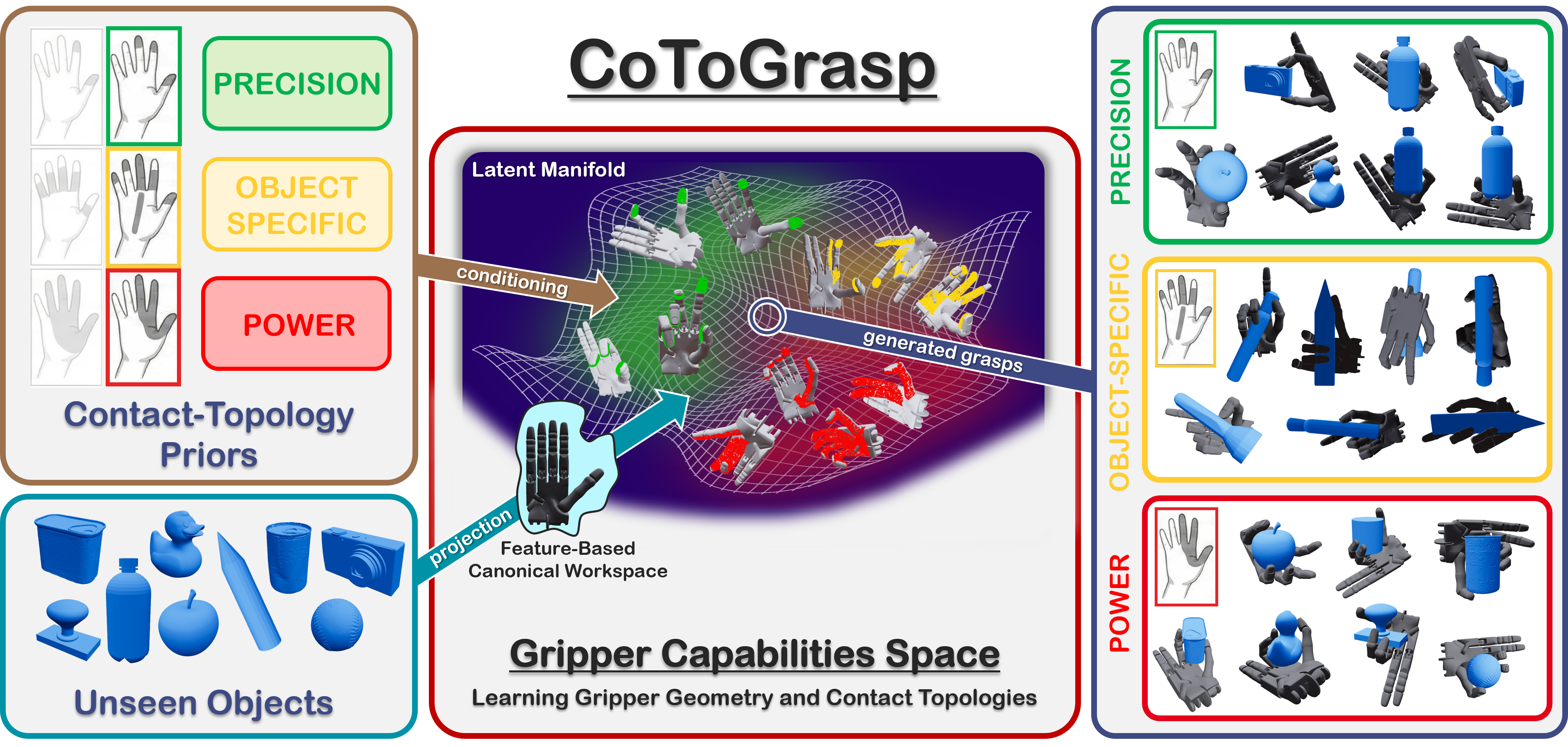
Current dexterous grasp planners primarily optimize for physical stability, focusing on whether an object can be grasped rather than how it should be grasped to support downstream functional tasks. However, conditioning grasp synthesis on specific human grasp taxonomies typically requires prohibitively expensive, object-annotated datasets. To address these limitations, we propose CoToGrasp, a novel generative framework that synthesizes diverse, stable grasps strictly conditioned on specific contact topologies. To bypass the data collection bottleneck, CoToGrasp is trained entirely in an object-agnostic manner. We introduce a feature-based canonical workspace that projects local object features into a unified gripper-centric domain, effectively decoupling the semantic functional intent from the arbitrary object geometry. By learning the intrinsic contact manifold of the gripper within this workspace, our model achieves zero-shot generalization to unseen objects at inference. Extensive evaluations on the large-scale DexGraspNet dataset demonstrate that CoToGrasp achieves state-of-the-art performance, outperforming existing taxonomy-guided planners. Finally, we demonstrate the physical viability and kinematic feasibility of our synthesized contact topologies on a physical robot platform.
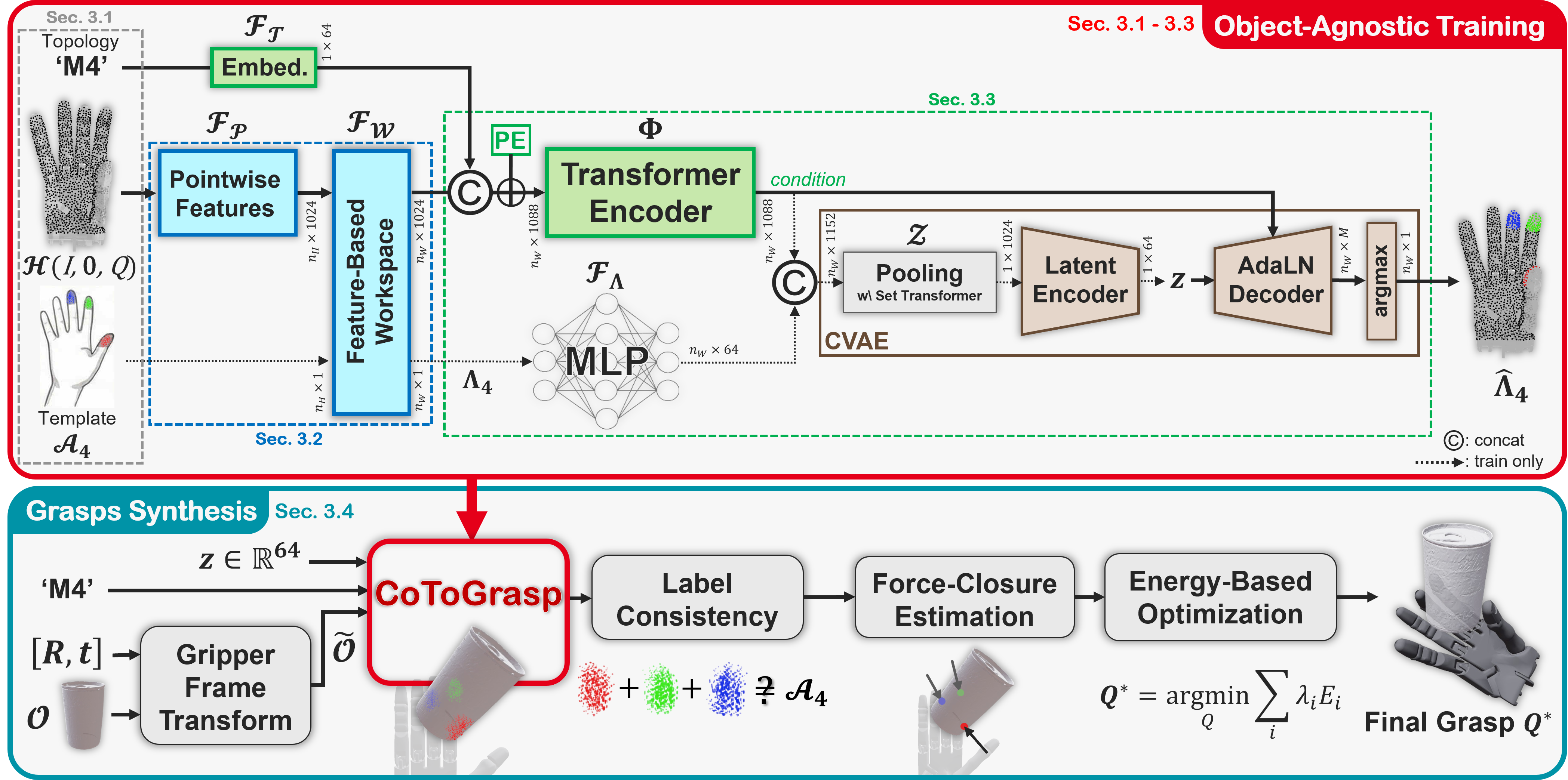
CoToGrasp Method Overview. The proposed framework operates in two distinct phases.
Object-Agnostic Training (Top): The model learns an intrinsic, gripper-centric contact manifold. Given a gripper point cloud $(\mathcal{H}(I, \mathbf{0}, Q))$ and a target grasp type (e.g., 'M4'), local geometric features are extracted and projected onto a canonical Feature-Based Workspace $(\mathcal{W})$. A Transformer Encoder processes these projected features alongside the type embedding to capture spatial dependencies, outputting a condition vector $(\Phi)$. Concurrently, a Conditional Variational Autoencoder (CVAE) models the stochasticity of valid contact zones to reconstruct the predicted semantic contact template $(\hat{\Lambda}_4)$.
Grasp Synthesis (Bottom): During inference, a target object $(\mathcal{O})$ is transformed into the canonical gripper frame $(\tilde{\mathcal{O}})$. By sampling a latent vector $(z)$ and conditioning on the target grasp type, the trained network predicts a semantic contact distribution on the object surface. This prediction is strictly filtered through a cascading validation pipeline (Label-Consistency and Force-Closure checks) to reject topologically invalid or unstable configurations. Finally, an Energy-Based Optimization aligns the gripper's kinematics to the validated contact points, yielding the final stable grasp $(Q^*)$.
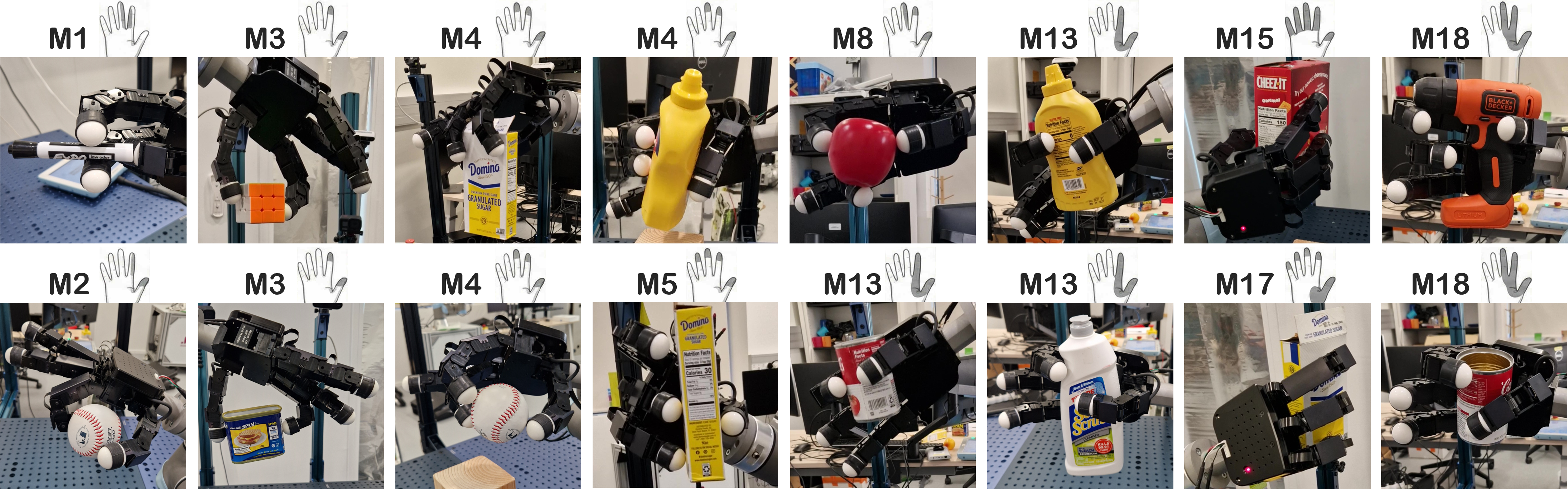
Real-World kinematic validation. CoToGrasp synthesizes diverse, topology-compliant grasps that are physically executable on a physical Allegro Hand using YCB objects. The target contact topologies (indicated above each frame) demonstrate the physical viability of the generated grasps across both precision and power categories.
Video Presentation
Qualitative Results: Synthesized Grasps and Real-World Experiments
Clustering of Shadow Hand Grasps.
Real-World Experiments.
BibTeX
@inproceedings{merand2026cotograsp,
  title={CoToGrasp: Contact-Topology-Conditioned Dexterous Grasp Synthesis via Canonical Workspace Learning},
  author={Mérand, Julien and Meden, Boris and Chen, Liming and Grossard, Mathieu},
  journal={19th European Conference on Computer Vision (ECCV)},
  year={2026},
  url={https://cea-list.github.io/cotograspweb/},
}